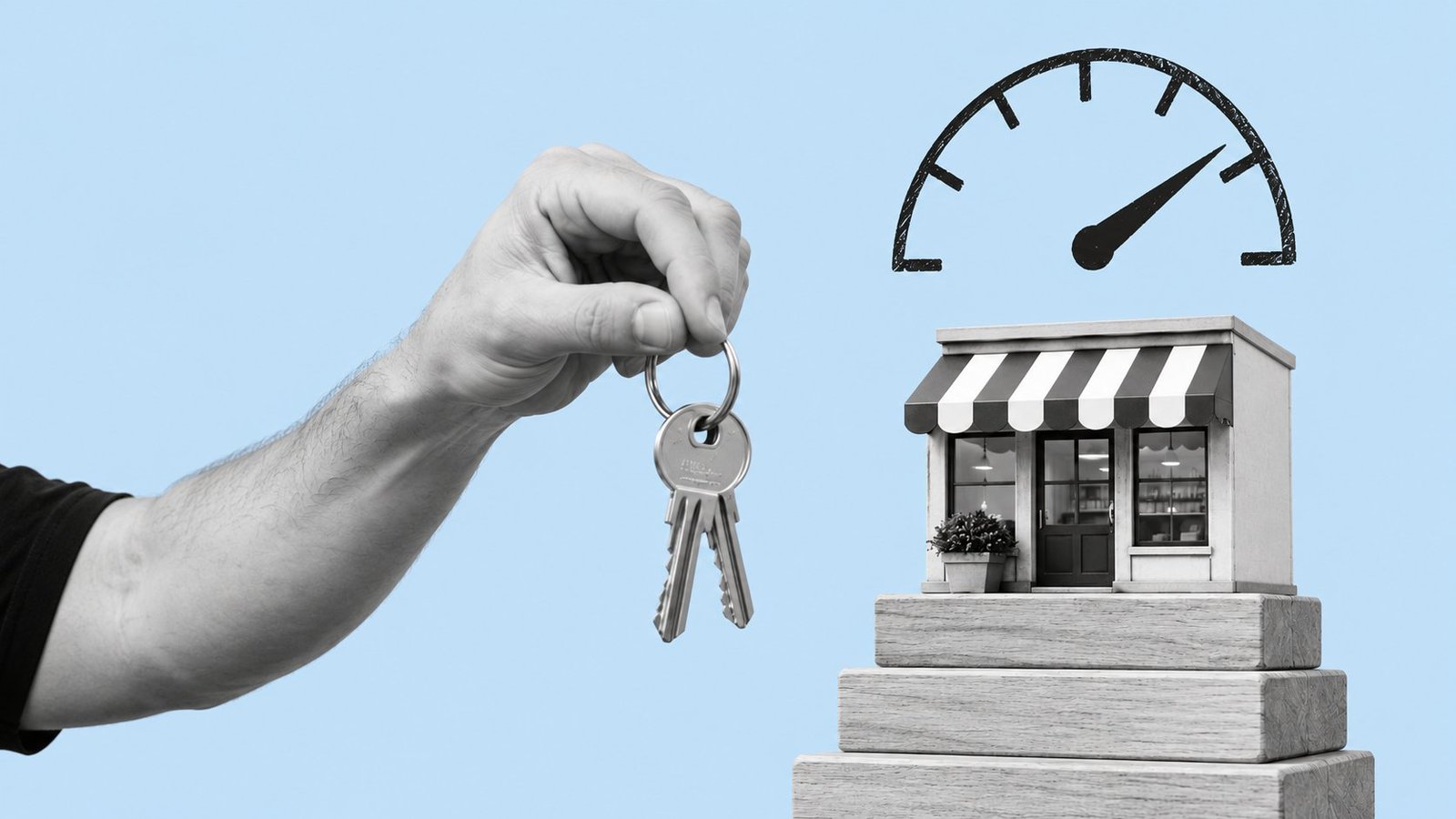
If you're thinking about selling your business, or you're already in the process, there's only one question you really want answered: "How do I get the highest price possible?" I know that because I've been through the process of selling a business, and it's the question I wanted answered too. The truth is that showing higher profits isn't always the answer. The fastest way to increase what your business sells for is to make it need you less.
Profit matters, but buyers pay a higher multiple for a business that runs without its owner, has clean books, has revenue heading the right way, doesn't depend on one customer, and sits on a lease that outlasts the loan they'll use to buy it.
Most of that takes 12 to 24 months to show up in your numbers. That's why the time to start is well before you list.
What This Looks Like in Numbers
Here's one business run through the Profit Lights valuation tool three times. Same industry (landscaping), same $180,000 net profit, same $60,000 paid to the owner, so the same $240,000 SDE every time. (SDE is net profit plus what the business pays its owner.) The only things that change are how much the business depends on the owner and which way revenue is heading. (Illustrative figures, not a real business.)
| Owner dependence | Revenue trend | Estimated value (multiple of SDE) |
|---|---|---|
| Very dependent | Declining | $529k–$630k 2.20x–2.62x |
| Somewhat dependent | About the same | $618k–$718k 2.57x–2.99x |
| Mostly independent | Growing | $699k–$800k 2.91x–3.33x |
Values are $240,000 SDE × the tool's multiple, rounded to the nearest $1,000. The multiples shown are rounded to two decimals, so multiplying them out by hand can differ by about $1,000.
Compare the first row with the last: the bottom of the range rises from $529k to $699k, and the top from $630k to $800k. That's about $170,000 more at both ends, on exactly the same profit.
Profit sets the starting point. How the business runs decides where in the range you land.
The Six Levers That Raise Your Price
1. Make Yourself Replaceable
This is the big one. A buyer isn't buying your profit. They're buying the profit that's left once you walk out the door. If you open up, place the orders, handle the difficult customers and hold all the supplier relationships, a buyer is really buying a job, and they'll pay a job's price for it.
A simple test: could the business run for two weeks without you, with no calls and no texts? If not, write down what would break. That list is your to-do list:
- Write down how things are done: opening, closing, ordering, recipes or specs, the passwords only you know.
- Train a second-in-command who can make day-to-day decisions.
- Hand your key customer and supplier relationships to someone on the team, and let them run those relationships while you're still there to back them up.
- Then step back, and let the numbers show the business held up without you.
2. Clean Up the Books
A buyer will rebuild your SDE from your own records, and BizBuySell advises sellers to have at least three years of organised financials ready: income statements, balance sheets and tax returns. Whatever you can't support with paperwork, a buyer will discount.
- Keep personal spending out of the business from now on, or at least track it clearly so it can be added back.
- Keep a simple file for every add-back: what it was, why it won't recur, and the receipt.
- Make sure your bookkeeping, bank statements and tax returns tell the same story.
Every add-back you can't prove gets struck off, and every dollar struck off costs you the multiple. If you want the full list of what counts, I walk through it in how to calculate SDE, step by step. How you handle personal costs and tax is a conversation for your accountant, not this article.
3. Get Revenue Heading the Right Way
Buyers price in the trend continuing. Declining revenue gets discounted harder than the raw numbers suggest, because the buyer assumes next year will be worse. If revenue has dipped, it's usually worth fixing the trend before you list rather than explaining it during the sale.
Recurring revenue helps even more. Contracts, subscriptions and regular wholesale accounts are easier for a buyer to trust than walk-in sales. That's a big part of why recurring-revenue businesses like self-storage sell for higher multiples than restaurants. (See SDE multiples by industry.)
4. Don't Depend on One Customer
If one customer brings in a big share of your revenue, a buyer sees a business that could lose that share the day after closing. The free Customer Concentration tool uses these bands for your single biggest customer:
- Under 10% of revenue: diversified, no real concentration risk.
- 10–30%: worth watching. Losing them would leave a real gap.
- 30% or more: a genuine concentration risk, and buyers and lenders will treat it as one.
The fix is rarely to lose the big customer. It's to grow the rest of the business around them, and to put that relationship on a contract where you can.
5. Sort Out the Lease
For any business that depends on its location, the lease is part of what's being sold. Two things matter to a buyer:
- Length. In the US, many small businesses are bought with SBA loans. For those, the lender generally wants your lease, including renewal options only the tenant can exercise, to run at least as long as the loan.
- Assignment. Check whether your lease can be transferred to a buyer, and on what terms. Many leases need the landlord's consent.
Talk to your landlord early, while you're a good tenant with no deal on the table, not when a buyer's lender is waiting on the paperwork.
6. Give It Time
Buyers judge you on the last 12 months and the last three years. A change you made last month doesn't show up in either. Handing off the day-to-day, cleaning up the books and turning a revenue dip around all need time to show in the numbers.
You can't fix in three months what a buyer will judge on three years. If you think you might sell in the next two or three years, start now.
Where to Start
Get a baseline first. Run your numbers through the free valuation tool. It takes about 60 seconds, and it shows which factors are helping your number and which are holding it back. Then pick the lever with the biggest gap and start there.
Profit Lights provides an educational estimate only and does not provide a certified, professional, accounting, tax, legal or investment valuation. Actual business value may vary significantly based on financial records, assets, liabilities, location, market conditions, deal structure, buyer demand and other factors.
More on Valuing Your Business
- How to Value a Small Business: The SDE Method — the one valuation method that fits an owner-operated business, and how to work out your SDE.
- How Much Is My Business Worth? — the quick formula, and the things that move your number most.
- SDE Multiples by Industry: Real 2026 Ranges — what businesses like yours actually sell for, across 16 industries.
- How to Price a Business for Sale — what add-backs, deal structure and due diligence do to your number before a sale closes.
About Me
I'm Michael Philippou, co-founder of Big Love, a plant-based ice cream business in Santa Monica that I've been running with my wife Victoria for over ten years. Before ice cream, I was a lawyer. I write about the real, unpolished lessons of running a small business — no gurus, no hype, just what's actually worked and what hasn't. Watch more on YouTube (Real Business Real Lessons) or follow along on LinkedIn.
Want to know how your business is actually doing? Start with the free Business Health Check — a couple minutes of questions and your email gets you a real score. Or dig into the other four: Valuation Estimator, Cash Runway, Customer Concentration Risk Checker, and Break-Even Calculator.