Search "how to value a small business" and you'll get the same answer from every bank, accounting firm, and government site: here are five methods — asset-based, market-based, income-based, EBITDA multiple, discounted cash flow — good luck picking.
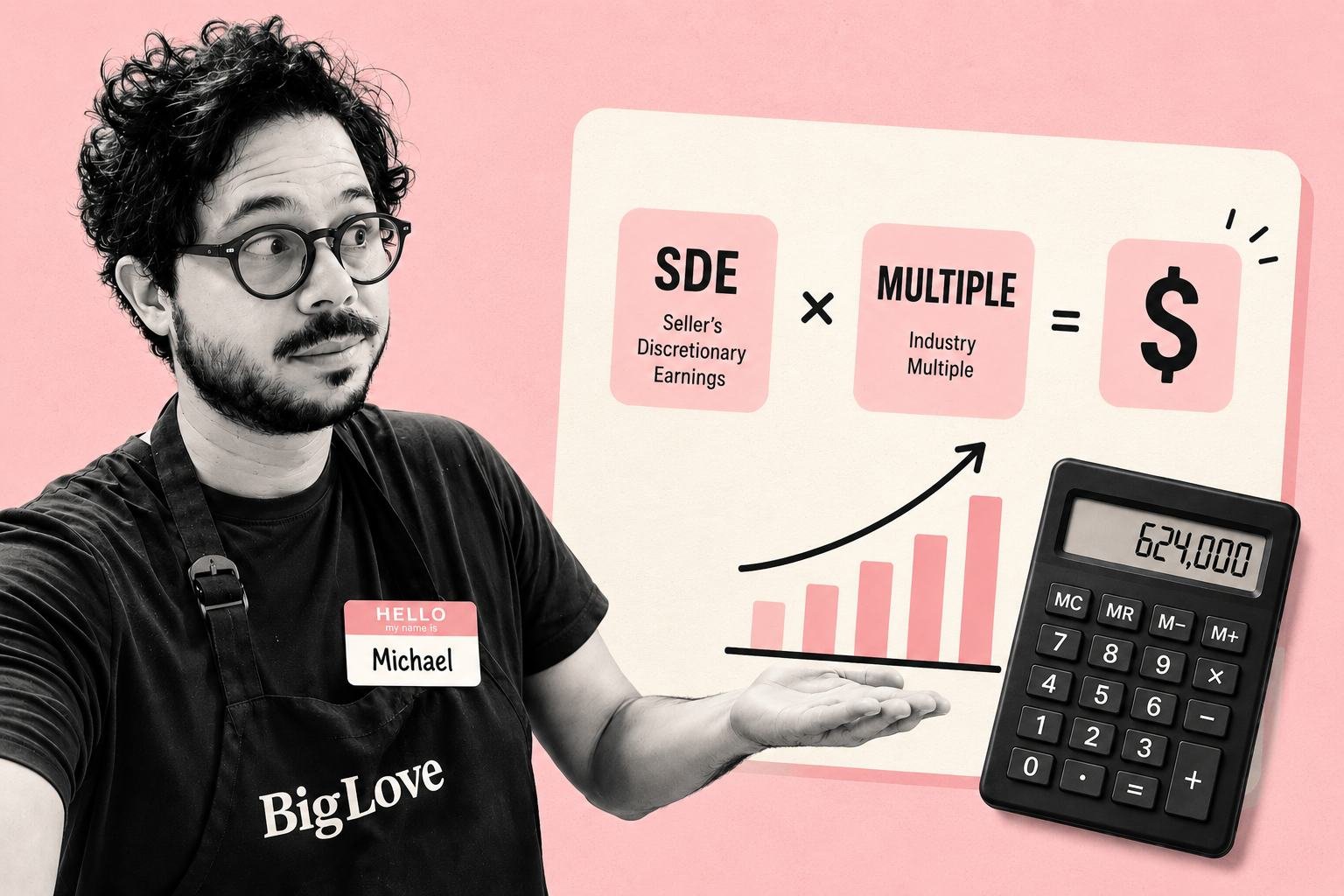
That's technically correct and practically useless. Most of those methods exist for businesses with boards, audited financials, and a finance team to run the numbers. If you own a shop, a service business, or anything else you built and run yourself, you don't need five methods. You need one: Seller's Discretionary Earnings (SDE) × an industry multiple.
Here's why that's the right one for you, and how to actually run it.
Why the Other Methods Don't Fit
EBITDA multiples are built for businesses with a management team already in place — the assumption is that a buyer steps in and the business runs the same way without you. If you're the one opening up, doing the ordering, and handling the tough customer conversations, EBITDA understates what your business is actually worth to a buyer, because it doesn't account for the fact that your own labor and judgment are baked into the earnings.
Discounted cash flow needs multi-year financial projections most small businesses don't formally produce. It's the right tool for a company raising institutional capital. It's the wrong tool for a business that does its books in QuickBooks and a shoebox of receipts.
Asset-based valuation works if your business's value sits mostly in equipment, inventory, or real estate. For most service and retail businesses, the real value isn't the fryer or the register — it's the cash flow the business generates. Asset-based methods miss that entirely.
That leaves SDE — built specifically for owner-operated businesses, which is exactly what most small businesses are.
What SDE Actually Means
SDE stands for Seller's Discretionary Earnings. In plain terms:
SDE = Net Profit + Owner Compensation
The logic: your salary, your health insurance, that trip you expensed, the extra owner's draw at the end of a good year — all of that is cash the business actually generated, even though it doesn't show up as "profit" on paper. A buyer isn't just buying your profit line. They're buying everything the business puts in an owner's pocket.
Once you have SDE, the valuation formula is:
Estimated Value = SDE × Industry Multiple
Where the Multiple Actually Comes From
This is the part most guides wave their hands at. The multiple isn't a guess — for owner-operated "Main Street" businesses (the industry term for businesses that sell for under roughly $2M), it comes from real closed transaction data. BizBuySell, which tracks the largest published dataset of small business sales, put the overall market range for owner-operated businesses at roughly 2x–4x SDE, with the median sitting closer to 2.7x.
Where you land in that range depends on things a buyer actually cares about:
Your industry. A recurring-revenue business like self-storage sits at the high end of Main Street multiples. A restaurant, with thinner margins and higher turnover risk, sits at the low end. Multiples aren't one-size-fits-all across industries, and a generic calculator that ignores this will hand you a wrong number either direction.
How dependent the business is on you. If everything runs through you personally — you're the only one who can run the kitchen, close the sale, or fix the problem — that pulls your multiple down, because a buyer is really buying a job, not a business. The more the business runs without you, the more it's worth.
Where your revenue is heading. Growing, flat, or declining revenue nudges the multiple in an obvious direction, but it matters more than most owners think — a business trending down gets discounted harder than the raw numbers suggest, because a buyer is pricing in the trend continuing.
Running the Numbers Yourself
Here's the actual math, using round numbers:
Say your business had $180,000 in net profit last year, and you paid yourself $60,000 in owner compensation.
SDE = $180,000 + $60,000 = $240,000
If you're in an industry where Main Street multiples run 2.0x–3.4x, and your business is reasonably independent of you day-to-day with flat-to-growing revenue, you might land around the middle-to-upper part of that range — say 2.6x.
Estimated Value = $240,000 × 2.6 = $624,000
Notice what that range does: it's not a single confident number, and it shouldn't be. Anyone who hands you one precise figure from a five-minute conversation is guessing with more confidence than the data supports. A real range, with the factors that move you within it, is more honest — and more useful.
What This Number Is (and Isn't)
This gets you an educational estimate — a genuinely useful starting point for understanding where your business likely sits, based on real market data rather than a guess. It is not a certified valuation, and it's not a substitute for a professional appraisal, accountant, or business broker if you're actually planning to sell, seek financing, or need a number that will hold up in a negotiation or a legal context. Actual value depends on your specific financials, assets, liabilities, deal structure, and buyer demand — all things a five-minute framework can't fully capture.
What it is good for: understanding roughly where you stand, seeing what actually moves your number up or down, and having an informed conversation instead of a guess.
Run Your Own Number
If you want to see where your business lands without doing the math by hand, Profit Lights has a free valuation tool that runs this exact SDE-based calculation — no financial documents to upload, just a few quick questions and your email to see the range. About 60 seconds start to finish. It'll also show you which factors are helping your number and which ones are holding it back, the same way we just walked through here.
Profit Lights provides an educational estimate only and does not provide a certified, professional, accounting, tax, legal or investment valuation.
About Me
I'm Michael Philippou, co-founder of Big Love, a plant-based ice cream business in Santa Monica that I've been running with my wife Victoria for over ten years. Before ice cream, I was a lawyer. I write about the real, unpolished lessons of running a small business — no gurus, no hype, just what's actually worked and what hasn't. Watch more on YouTube (Real Business Real Lessons) or follow along on LinkedIn.
Want to know how your business is actually doing? Start with the free Business Health Check — a couple minutes of questions and your email gets you a real score. Or dig into the other four: Valuation Estimator, Cash Runway, Customer Concentration Risk Checker, and Break-Even Calculator.