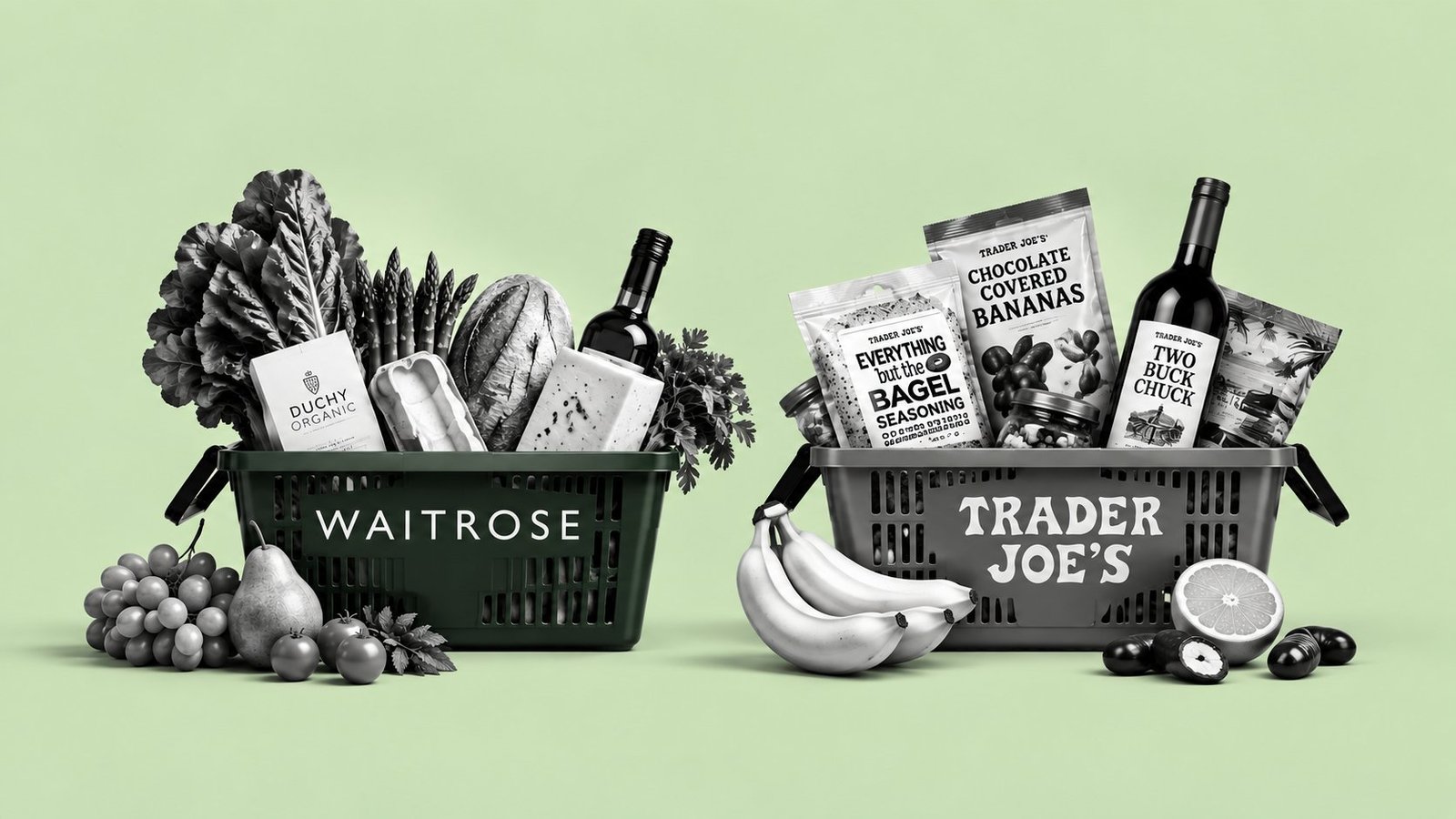
The Thesis
If you have ever lived in the States, and particularly in California, you will have heard of Trader Joe's. In all my time in America — over ten years — I have never once heard anything bad said about the place. This is despite the fact that the car parks outside a Trader Joe's are an absolute nightmare to navigate across Los Angeles. I have never met a disgruntled or unhelpful team member there, and I've never heard anyone complain about it either. Ask any Angeleno — which is where I spent most of my time in the States — and they will tell you, without hesitation: "I love Trader Joe's."
That's despite the fact that Trader Joe's carries only around 4,000 products — roughly a tenth of a typical large supermarket's range. Most strikingly, around 80% of what's on the shelf carries one of its own brand names. It has no loyalty card, runs almost no advertising, and yet has built one of the most talked-about, most defended fan bases in American retail — with sales per square foot that Fortune estimated at roughly $1,750, more than double Whole Foods. People don't just buy Trader Joe's products. They evangelise them, mourn discontinued ones, and plan trips around what's new.
I've personally planned trips around picking up "Two Buck Chuck" (Charles Shaw, the Trader Joe's-exclusive wine that launched at $1.99 a bottle) or a bag of their chocolate-covered frozen bananas. That's not normal grocery-shopping behaviour, and that's the point.
The fact is Trader Joe's isn't just a private-label cost story. It's a loyalty story that happens to be delivered through private label — and that's the part most "own-brand is good for margin" conversations miss entirely.
Here's my argument for Waitrose.
Waitrose has spent decades building a genuinely strong own-label portfolio — Essential Waitrose through to Duchy Organic — largely as a margin and value-ladder tool. The bigger opportunity is treating fewer, more distinctive, more curated Waitrose-exclusive products as the actual reason people choose to shop there, not simply the cheaper option once they're already in the store.
Why This Isn't "Turn Waitrose Into Trader Joe's"
I want to be precise about what's being proposed, because the comparison breaks immediately if taken literally. Waitrose is a full-range premium British supermarket serving an affluent, quality-seeking customer base, competing on breadth as much as curation. Trader Joe's is a discovery-format specialty grocer that deliberately isn't anyone's only shop — though it's worth saying plenty of people do treat it as exactly that, doing a full weekly shop there despite the narrower range. Waitrose cannot and should not cut its range to 4,000 products — its customers rely on it as a complete weekly shop, not a treasure-hunt top-up store.
What transfers isn't the product count. It's the underlying mechanism:
Curation and exclusivity, deployed deliberately in specific categories, can make the retailer's own products the actual draw — not the private-label fallback.
Where Waitrose Already Has the Raw Material
This isn't a cold start. Waitrose's own-label architecture already spans entry-level Essential Waitrose through core ranges to genuine premium and organic specialties like No.1 and Duchy Organic — and the premium end is growing fast, with No.1 sales up 15% in the first half of this year. The John Lewis Partnership's own stated strategy — Waitrose as "the home for food lovers," built on its own-label ranges and products from its own farm, the Leckford Estate — is already pointed in this direction. The ingredients exist. What's underdeveloped is the emotional and discovery layer Trader Joe's has built on top of similar raw materials.
Trader Joe's four real mechanisms, translated to what Waitrose could specifically do:
- Genuine exclusivity, not "own version of." Trader Joe's products aren't cheaper alternatives to national brands sitting on the same shelf — they're often the only version, developed directly with producers. Waitrose has this in pockets (Duchy Organic, chef collaborations) but could push further: fewer duplicate branded products in a category, more genuinely unique Waitrose-only products people can't buy at Tesco or Ocado.
- Deliberate rotation and scarcity. Trader Joe's regularly discontinues loved products on purpose, creating urgency and a reason to keep checking back. Waitrose's seasonal and chef-collaboration ranges already gesture at this; formalising a rotating "discovery" tier — clearly signposted, genuinely limited — would borrow the mechanism without copying the format.
- A voice, not a catalogue. The Fearless Flyer (Trader Joe's own customer newsletter) works because it tells stories about where products come from rather than just listing prices. Waitrose has real provenance stories — British farms, welfare standards, named producers — that are underused as narrative, not just small print on packaging.
- Staff as advocates, not assistants. Trader Joe's "Crew Members" actively recommend products from firsthand knowledge. Waitrose already talks about the expertise of its Partners; the test is whether that becomes genuine product advocacy for Waitrose-exclusive items specifically, not just general helpfulness.
Where the Comparison Breaks Down — and What Waitrose Should Not Copy
- Waitrose's customer isn't shopping for a treasure hunt; they're shopping for a reliable full basket. Trader Joe's customers accept going elsewhere for anything Trader Joe's doesn't stock. A Waitrose customer generally expects Waitrose to be a complete weekly shop. Cutting choice too aggressively risks pushing baskets to Ocado, Tesco, or M&S rather than building loyalty — this has to be additive curation in specific categories, not range reduction across the board.
- Waitrose is fighting a share battle Trader Joe's doesn't face. Waitrose is growing again — sales up 5.8% in the 12 weeks to March 2026, its fastest rate in five years, for a 4.7% share of the GB grocery market. But at the premium end, its competitors are growing faster: Ocado's sales rose 12.3% over the same period, more than double Waitrose's rate, and M&S's grocery sales rose 9.5%. A curation strategy takes time to build cult status; in the meantime, Waitrose is competing against retailers growing faster right now on convenience and value, not curation. This is a multi-year brand-equity play, not a quarter-by-quarter share fix — it needs to be sold internally as that.
- No loyalty card is not free for Waitrose to copy. Trader Joe's rejection of loyalty programmes works partly because it has no direct competitor doing the same thing in its category. Waitrose already runs myWaitrose, which is still growing and gives it real first-party data. Abandoning it to "be more Trader Joe's" would be copying an aesthetic choice, not the underlying strategic logic — the data asset is worth more to Waitrose than the anti-loyalty-card mystique is.
- Premium pricing changes what "exclusivity" signals. Trader Joe's exclusivity reads as value discovery — a great product you can only get here, at a fair price. At Waitrose's price point, the same mechanic risks reading as simply expensive rather than special, unless the quality and story genuinely justify it every time. This only works if the curated tier is demonstrably better, not just differently branded.
The Back-of-Envelope Test
It's worth putting a number on what "market share" actually means here, because a tenth of a percentage point can sound trivial until it's converted into revenue.
Worldpanel by Numerator (formerly Kantar) puts Waitrose at 4.7% of the GB grocery market in the 12 weeks to 22 March 2026. Waitrose's own reported sales were £8.0bn in 2024/25.
- One-tenth of one point of GB grocery share ≈ £170m in annual revenue. If £8.0bn of sales is roughly 4.7 points of share, each tenth of a point is worth about £170m a year. That's the size of the prize (or the cost of standing still) hiding inside a single decimal point that gets reported every month and barely discussed.
- Waitrose is growing — just not as fast as the premium competition. Its 5.8% sales growth is its best in five years, and a genuine turnaround. But Ocado grew 12.3% and M&S 9.5% over the same 12 weeks. The premium shopper's extra spend is real, and a large share of it is going somewhere other than Waitrose.
- The money is already being spent — the question is on what. The John Lewis Partnership committed up to £600m of investment in 2025/26, up from £450m the year before, much of it catch-up in stores and the supply chain. And Waitrose is already leaning on own label: No.1 grew 15% in the first half of 2026/27, backed by more than 540 new product launches.
That last figure is the actual argument. 540 new products in six months is more choice. The Trader Joe's lesson is fewer products that people choose you for. The open question isn't whether Waitrose is investing enough in own label — it's whether "extend the range, launch more own-label products" is the same lever as "curation and exclusivity that makes people choose Waitrose specifically," or whether it's the wrong version of the same idea.
Why this has to be judged over years, not quarters: Waitrose's share has moved within a few tenths of a point for years; there's no reason to expect a curation strategy to move it faster than that. The test for a pilot category (say, one or two aisles converted to a curated, story-led, rotating format) shouldn't be "did share move this quarter" — it should be repeat-purchase rate and unprompted product mentions and searches for the specific exclusive items, which are the leading indicators Trader Joe's own cult status is actually built on, long before any share number would move.
Market share and sales growth figures are from Worldpanel by Numerator (12 weeks to 22 March 2026); Waitrose sales and investment figures are from John Lewis Partnership published results. The ~£170m per tenth of a point is my own calculation from those inputs, not a Waitrose-published number — Waitrose's reported sales don't map exactly onto Worldpanel's take-home grocery measure — so treat it as an order-of-magnitude estimate rather than a precise revenue figure.
What This Would Actually Require
Not a rebrand. A deliberate choice, category by category, to identify where Waitrose is currently stocking three or four near-identical branded and own-label options and instead commit to one genuinely distinctive Waitrose-exclusive product — backed by a real story, a limited-run mentality where appropriate, and staff empowered to talk about it specifically. Measured not on private-label margin uplift alone, but on whether it changes why someone chose to shop at Waitrose that week.
Having spent long periods in both the US and the UK, I genuinely believe Waitrose is one of the few British retailers positioned to capture some of that Trader Joe's magic here. You might argue M&S is the closer British equivalent — I don't think that's right; M&S skews toward an older, more traditional demographic. Trader Joe's may simply be too "American" to transplant directly to the UK, but that doesn't mean Waitrose isn't perfectly placed to borrow what makes it work so well.
About Me
I'm Michael Philippou, co-founder of Big Love, a plant-based ice cream business in Santa Monica I've been running with my wife Victoria for over ten years. Before ice cream, I was a lawyer. I write about the real, unpolished lessons of running a small business — no gurus, no hype, just what's actually worked and what hasn't — at profitlights.com, where you'll also find a few free tools and the rest of my writing. You can find more of these stories on my YouTube channel, Real Business Real Lessons, or connect with me on LinkedIn.
Want to know how your business is actually doing? Start with the free Business Health Check — a couple minutes of questions and your email gets you a real score. Or dig into the other four: Valuation Estimator, Cash Runway, Customer Concentration Risk Checker, and Break-Even Calculator.