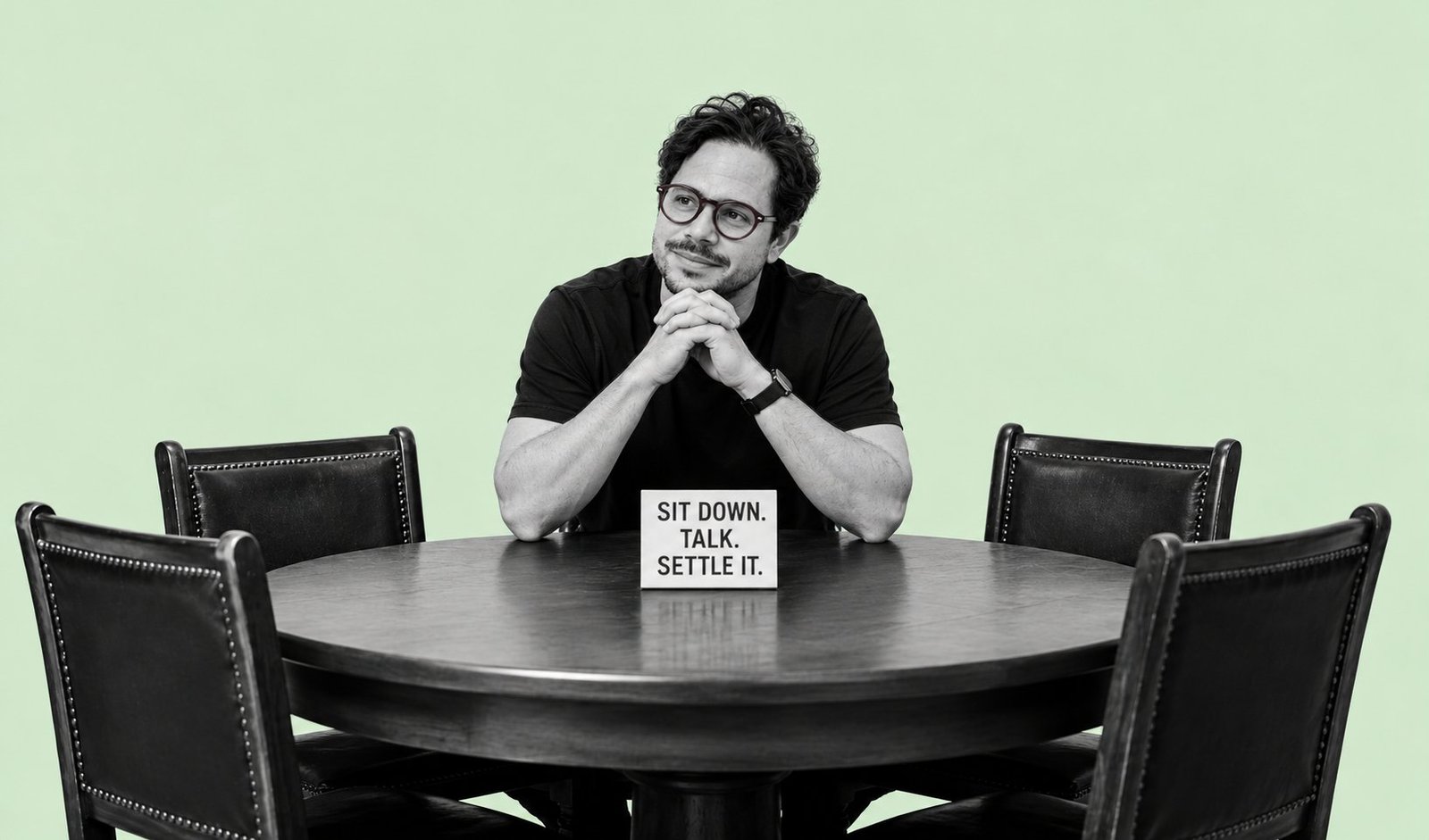
There's one ritual every leader should borrow from mob movies: the sit-down. Put the two people with the problem in the same room, hear both sides, settle it and move on.
Watch almost any Mafia film and you'll see this exact scene. Two men have a grievance. Maybe someone was disrespected, maybe money went missing, maybe a line was crossed. The feud starts spreading. Eventually someone higher up decides enough is enough and calls a sit-down.
It's often the turning point of the story.
Any Godfather buff will know the Five Families scene. After the death of his son Sonny, Don Vito Corleone calls the heads of New York's Five Families together in a boardroom for a big sit-down. Each side airs its grievance, mostly about the narcotics business and who started the war. Vito then publicly gives up revenge for his son's death in exchange for peace and his son Michael's safe return from Sicily. Everyone agrees, and the war ends at the table. That peace doesn't last, but this is a Mafia movie, after all.
The methodology is simple. Everyone involved comes to the table. Each side says what happened without being interrupted. Someone senior listens, then rules. And everyone is expected to live with the ruling.
I'm not recommending organized crime as a management model. But I've run a small business for 14 years, ten of them in the US, and I've come to think the sit-down captures something most organizations are missing: a recognized, low-ceremony way to deal with ordinary friction before it hardens into something worse.
Conflict isn't the problem. Conflict that never reaches the right room is.
The Real Cost Is the Conversation That Doesn't Happen
Here is how a small disagreement usually spreads. Employee A is annoyed with Employee B. A doesn't tell B; A tells C. C mentions it to D. Eventually the manager hears and speaks to B separately, and B has a completely different version of events. Now B is annoyed too, because B knows A has been talking. Something a ten-minute conversation could have fixed has drawn in half the team.
The version I see more often: an employee fundamentally disagrees with their manager. Feeling unheard, they build resentment. Communication breaks down, and a great employee becomes, well, an underperforming one.
The numbers suggest this is normal, not exceptional. In CPP's 2008 Global Human Capital Report, 85% of employees said they deal with conflict to some degree, and U.S. employees spent an estimated 2.8 hours a week on it — about $359 billion in paid hours that year. A quarter of respondents said they had seen conflict lead to sickness or absence.
Avoidance has its own price tag. In a 2016 survey of more than 1,000 people by Crucial Learning (formerly VitalSmarts), respondents estimated that each crucial conversation they failed to have (one where the stakes are high, opinions differ and emotions run strong) cost their organization an average of $7,500 and more than seven workdays, mostly spent complaining to others and ruminating. In its 2021 follow-up survey of 1,100 people, the costliest conversation employees avoided was one about a colleague showing disrespect to someone else.
Sound like a Mafia movie you've seen?
That is exactly the territory of the sit-down: not misconduct, not strategy, but the everyday friction between people who have to keep working together.
Why Structure Makes It Worse
The research on team conflict draws a useful line. Task conflict is disagreement about the work: priorities, methods, who should do what. Relationship conflict is personal friction: tension, irritation, feeling slighted.
A 2012 meta-analysis of 116 studies covering 8,880 groups, by Frank de Wit, Lindred Greer and Karen Jehn, found relationship conflict was consistently bad for group outcomes. Task conflict was not. On its own it was neither clearly good nor clearly bad. It tended to be more positive when it stayed separate from relationship conflict, and in top management teams and decisions judged on quality or financial results.
That is the managerial insight. The danger isn't disagreement about the work. It's disagreement about the work that's allowed to turn personal. And the longer an issue travels through intermediaries, the more personal it gets.
Larger organizations have more intermediaries. Employee talks to supervisor, supervisor to manager, manager to HR, HR to another manager. Each layer exists for good reasons. But each is also a place where two people can avoid ever talking to each other. Email and Slack make it easier still.
Small businesses can't hide from this. If you have 5,000 employees and two don't get along, the organization absorbs it. If you have five and two aren't speaking, 40% of your workforce is in a feud, and every customer on that shift can feel it. Small-business owners are forced to deal with things directly. Sometimes badly, but directly. Bigger companies can learn from that.
How to Run a Sit-Down
This shouldn't become another heavy framework; that would defeat the point. Five rules are enough.
- Only the principals. The people who actually have the disagreement, plus one convener. Not their allies, and not everyone who has since heard about it.
- A neutral convener. Usually the manager both people report to, or a respected peer if the manager is part of the problem. Their job is to keep order and, if needed, make the call, not to take sides in advance.
- Each side speaks uninterrupted. People routinely experience the same event in completely different ways. Hearing the other version in full is often where most of the heat goes out of it.
- One issue on the table. A dispute about who was meant to close up on Tuesday must not become a review of everything someone has done wrong since 2023. Deal with what you came to deal with.
- Leave with a decision. An apology, a clarified responsibility, a changed process, or simply each side understanding the other. Write it down in a line, and say who does what by when.
Then comes the hardest part for most organizations: move on. Once something is genuinely settled, let it stay settled. Don't reopen the case every time something new goes wrong.
Safe to Speak, Binding to Leave
The sit-down only works if people can say what they actually think. That means one firm guarantee: no one is penalized for raising the issue or for how they describe their side of it. What's said at the table isn't repeated outside it, and it doesn't show up in anyone's next performance review.
This is what Amy Edmondson calls psychological safety: a shared belief that a team is safe for interpersonal risk-taking. Her research, beginning with a 1999 study of 51 work teams at a manufacturing company, links it to better team learning and, through learning, better performance. But Edmondson is also clear that psychological safety isn't about being nice. It's about candor.
So the sit-down isn't consequence-free. Speaking is safe; the outcome is binding. In the films, the ruling is the point. In a business, the stakes are gentler but the principle is the same: once both sides have been heard and a decision is made, people are expected to honor it. A sit-down that ends in nothing is just a venting session, and venting without resolution can make things worse.
When Not to Call One
The sit-down is for ordinary friction between people on roughly equal footing. It is the wrong tool for:
- Harassment, discrimination, bullying or safety concerns, which need formal procedures and protection for the person raising them
- Serious misconduct or anything with legal exposure
- Disputes with a large power gap, such as an employee and their own boss, unless someone senior to both (in a small business, often the owner) can convene it and honestly promise that speaking is safe
- Situations where one person fears the other
In those cases, putting both parties at the same table can do real harm. The convener's first job is to decide which kind of problem this is.
Make It a Standing Tool, Not a Last Resort
In the films, a sit-down is called when a feud is about to turn violent. In a business, the value comes from calling it early and often enough that it carries no stigma.
- Give it a name. When "let's do a sit-down" is part of the team's vocabulary, asking for one stops feeling like an accusation.
- Let anyone request one. Not only managers. The person who feels wronged should be able to ask, and so should the person who senses they're being talked about.
- Set a time limit. Thirty minutes is usually plenty. Any longer and it's drifted into a second issue.
- Use it before the process. Before another email, before HR, before people pick sides. Formal procedures remain available; the sit-down simply comes first for ordinary friction.
- Follow up once. A short check a week or two later on whether the agreed fix happened. Then let it go.
This fits a broader view of what managers are for. Their job isn't only to issue instructions downward. It's to remove what gets in the way of good work, and unresolved friction between two colleagues is one of the most common obstacles there is.
The Point Isn't Harmony
A healthy business isn't one where nobody disagrees. If no one in your company ever disagrees, I'd be worried. People should challenge decisions and occasionally annoy each other.
The goal is to stop disagreement about the work from curdling into something personal, and that takes something no HR policy can fully replace: two people willing to sit across from each other and have an uncomfortable conversation.
Most of the Mafia's management manual can stay unread. On the sit-down, though, they had a point. Sometimes you don't need another email or another meeting about the meeting. You need the right people in the room, an honest conversation, a decision, and permission to move on.
Sources
- CPP Inc., Workplace Conflict and How Businesses Can Harness It to Thrive, CPP Global Human Capital Report, July 2008 (85%, 2.8 hours a week, $359 billion; summary via EHS Today).
- Crucial Learning (VitalSmarts), Costly Conversations, December 2016 study of 1,025 people ($7,500 and seven-plus workdays); and December 2021 follow-up study of 1,100 people.
- de Wit, F. R. C., Greer, L. L., & Jehn, K. A. (2012). The paradox of intragroup conflict: A meta-analysis. Journal of Applied Psychology, 97(2), 360–390.
- Edmondson, A. (1999). Psychological Safety and Learning Behavior in Work Teams. Administrative Science Quarterly, 44(2), 350–383.
- HBR IdeaCast, Creating Psychological Safety in the Workplace, with Amy Edmondson, January 2019.
About Me
I'm Michael Philippou, co-founder of Big Love, a plant-based ice cream business in Santa Monica I've been running with my wife Victoria for over ten years. Before ice cream, I was a lawyer. I write about the real, unpolished lessons of running a small business — no gurus, no hype, just what's actually worked and what hasn't — at profitlights.com, where you'll also find a few free tools and the rest of my writing. You can find more of these stories on my YouTube channel, Real Business Real Lessons, or connect with me on LinkedIn.
Want to know how your business is actually doing? Start with the free Business Health Check — a couple minutes of questions and your email gets you a real score. Or dig into the other four: Valuation Estimator, Cash Runway, Customer Concentration Risk Checker, and Break-Even Calculator.