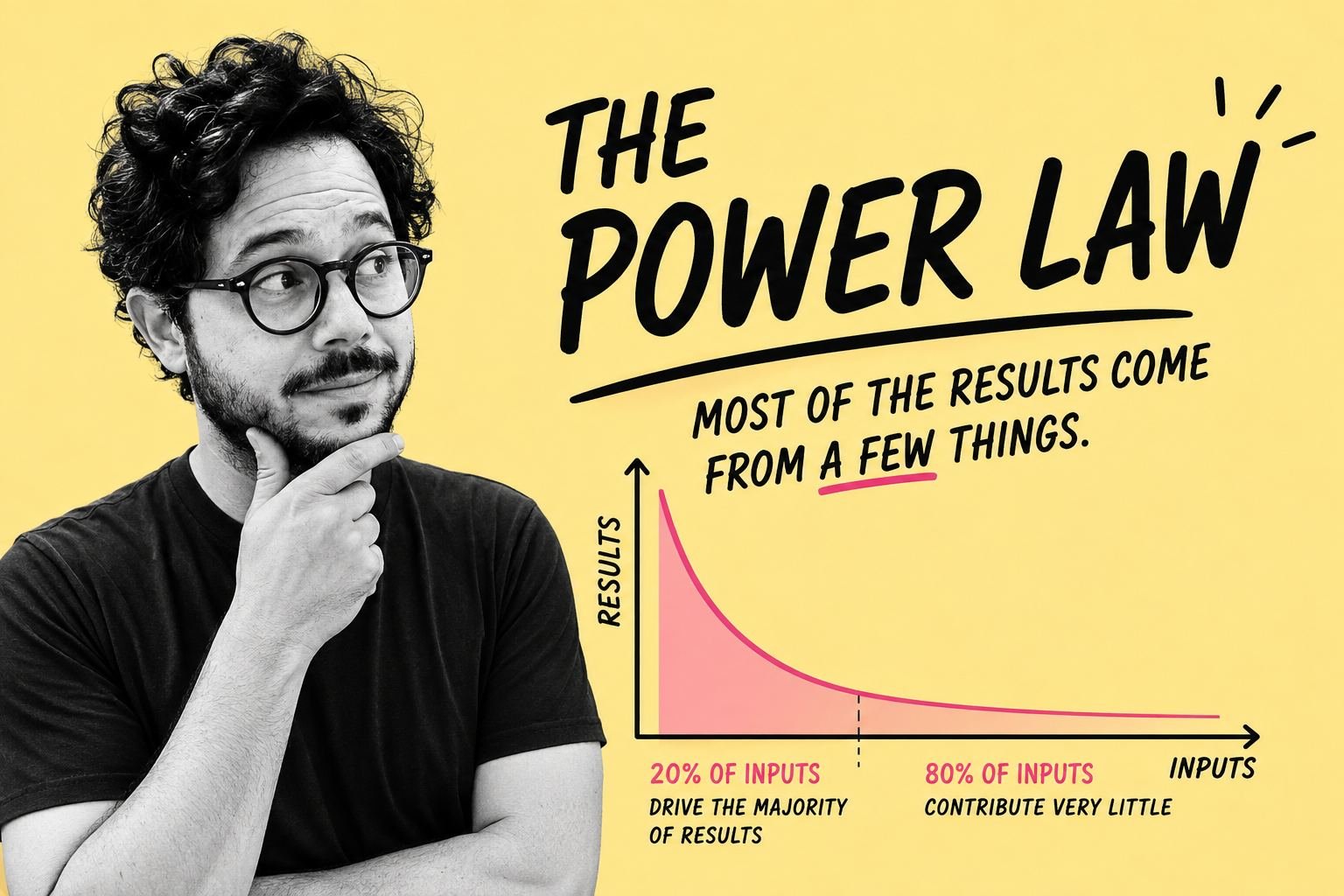
Every article about the power law is written for the same person: a venture capitalist deciding which startups to fund, hoping one of them turns into the next Google and makes up for the nine that fail. Peter Thiel built half of Zero to One around it. The pitch is always some version of: most of your bets will lose, but the rare huge winner will more than make up for it — so concentrate hard on finding that one outlier.
If you don't run a venture fund, none of that is directly useful. You're not placing ten bets hoping one becomes a unicorn. You have one business, and you show up to run it every day.
But the underlying math — the power law itself — isn't actually a venture capital concept. It's a description of how results distribute in almost any system with enough data points: a small share of inputs tends to produce a disproportionate share of the output. VC just happens to be the industry that talks about it the most loudly. It's quietly true inside your business too, whether you've ever looked for it or not.
What the Power Law Actually Says
You've probably heard a version of this as the 80/20 rule, or the Pareto Principle — named after Vilfredo Pareto, who noticed in the 1890s that roughly 80% of Italy's land was owned by about 20% of the population. The specific ratio isn't the point. Sometimes it's 80/20, sometimes it's more extreme — 90/10, or even 95/5. The point is that results are almost never evenly spread. A small number of things account for most of what happens.
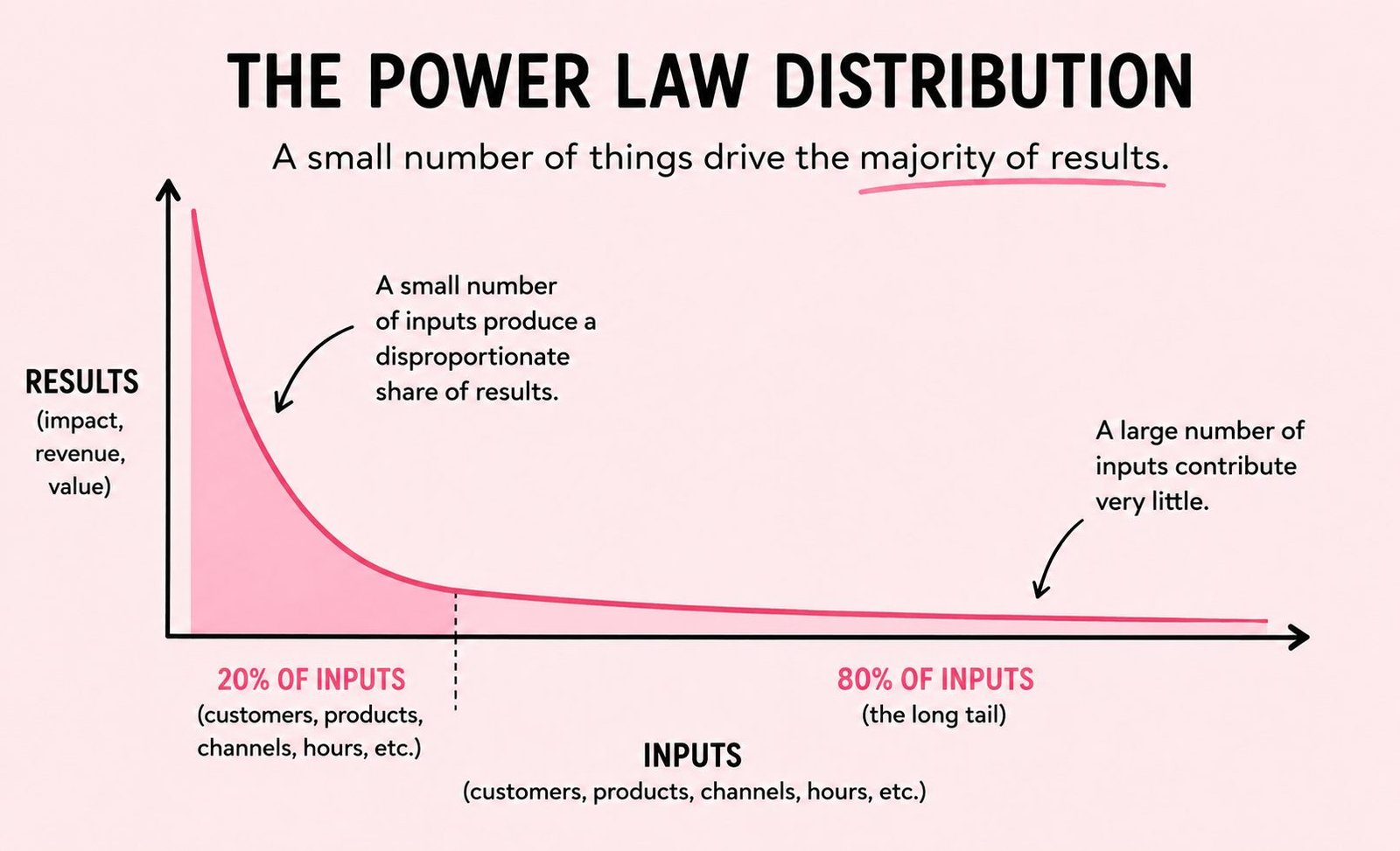
The power law isn't some random psychological or human phenomenon. It shows up all over the place — even in nature (earthquakes, forest fires, and plenty more). When I first came across the concept, I struggled to picture it. Here's how I explain it to myself:
You buy 10 random plants for your garden and plant them all at the same time. Most people would assume the growth rates average out — some do well, some do okay, some die, and it evens out somewhere in the middle.
That isn't usually what happens. There often isn't anything close to a normal distribution across a random group of plants. It's entirely possible that nine of them die and one turns into an absolute beast — dominating the garden so completely that its growth alone drags the average for all ten plants far higher than if all ten had just grown "okay."
That's the process most VCs and investors are actually relying on. It doesn't matter if you've invested in 100 companies and 99 of them fail, as long as one of them is a "beast" that returns 10,000x your money. If I have $10 million in a fund and invest $1 million equally into 10 companies, I'm working the power law. Most of those companies will fail. A few will do okay. I'm hoping one does exceptionally well — because while I can lose the full $10 million, my upside is effectively unlimited thanks to that one long-tail outcome.
The distribution of success doesn't have to be equal. In a business, that shows up in places most owners have never actually measured:
A small number of your products or menu items probably generate a disproportionate share of your revenue. A small number of your customers probably account for a disproportionate share of what you actually collect. A small number of your marketing channels probably bring in most of your new business, while the rest quietly do almost nothing. A small number of hours in your week — maybe a specific day, a specific shift — probably do most of the heavy lifting, while other hours barely cover their own cost.
None of that is a theory. It's just what happens when you actually pull the numbers and look, instead of assuming everything contributes roughly equally.
A Real-Life Example: The Grocery Store
My favorite example of this, outside of VC and the stock market, is something we're all familiar with — the grocery store. Walk into any grocery store and you'll see aisle after aisle of food products. There are probably thousands of individual items on the shelves.
If you looked at that store's actual sales, you'd almost certainly find a power law distribution. Most of their revenue comes from a small subset of product categories — bread, bananas, jarred sauces, beer, and a handful of others. I know this is true because grocery store buyers have told me exactly that, on two separate occasions, in two different geographic locations.
It's why they're willing to test out smaller, newer products on the shelves without much concern over whether they individually sell well. The store's main stable of products is already doing the heavy lifting. One buyer told me they happily rotate in a new item every month just so customers see something different in the ice cream freezer — fully aware that, more often than not, the customer's still going to pick up the same brand and flavor of vanilla they always do.
It's worth saying clearly: the power law doesn't apply to every situation. An airline can't rely on a handful of unusually busy flights to carry the rest — there's only so many seats on any given plane. A restaurant can't rely on a few unusually busy days to carry the month — the averages over time work against that kind of concentration. Knowing where this framework genuinely applies, and where it doesn't, matters as much as knowing that it exists.
A Worked Example: Your Product Mix
Say you run a business with 20 products on the menu, and $10,000 in revenue last month. Most owners assume revenue is spread out fairly evenly — 20 items, so each one is contributing something in the ballpark of $500.
Now say you actually pulled the sales report and it looked like this instead:
Top 4 products (20% of the menu): $6,800 (68% of revenue)
Middle 8 products (40% of the menu): $2,600 (26% of revenue)
Bottom 8 products (40% of the menu): $600 (6% of revenue)
That's a power law distribution, and it's a far more common shape than an even spread. The top fifth of your menu is doing more than two-thirds of the work. The bottom 40% — eight separate products, each with its own ingredients, prep time, and shelf space — is collectively contributing less than a tenth.
Most owners have never actually run this breakdown. They keep the whole menu because removing anything feels like leaving money on the table. But if you don't know the actual distribution, you can't tell the difference between a product that's quietly propping up the business and one that's quietly costing you time, ingredients, and mental overhead for almost nothing back.
A Worked Example: Your Customer Base
The same pattern shows up in who's actually buying from you. Say you have 200 regular customers and $10,000 in monthly revenue.
If the top 20% of those customers (40 people) account for 65% of that revenue ($6,500), and the bottom 40% (80 people) account for barely 8% ($800) — that's the same shape again. A small group of people are effectively carrying the business, while a much larger group barely register.
This is worth knowing for a reason that has nothing to do with cutting anyone off. It changes what you should actually spend your limited attention on. A loyalty program, a personal thank-you, a heads-up about a new product — those things matter enormously to the 40 people responsible for two-thirds of your revenue, and matter very little, spread thin, across the other 160. Most small businesses market and communicate as if every customer deserves equal attention. The power law says that's rarely the best use of a small business owner's limited time.
The Mistake Most Owners Make Because of This
Here's where power law thinking cuts against a very natural instinct: the instinct to diversify. Offer more products, chase more customer segments, try more marketing channels — spread the risk, cover more ground. That instinct makes sense in a stock portfolio. It's often exactly backwards in a small, owner-run business.
You don't have a portfolio of a thousand products where a few winners can quietly carry a long tail of losers, the way a venture fund does. You have one business, and every extra product, every extra marketing channel, every extra hour spent chasing a customer segment that barely moves the numbers is time and attention taken directly away from the small number of things actually driving results.
Diversification protects you when you can afford for most of your bets to fail. In a business you're running yourself, with your own hours and your own capital, the better move is usually the opposite: find out what's actually doing the work, and put more of your limited time behind it — rather than spreading yourself thinner trying to prop up everything equally.
What To Actually Do With This
Once you've pulled the real numbers — which products, which customers, which channels, which hours are doing the disproportionate work — a few things usually become obvious:
Cut or fix the long tail. The bottom products or channels contributing almost nothing aren't neutral. They cost shelf space, prep time, inventory complexity, and mental overhead. Sometimes the right move is dropping them. Sometimes it's a small price change or a menu placement fix. Either way, you can't make that call without knowing which items are actually in the long tail.
Double down on what's already working. The instinct when something's succeeding is often to move on and find the next thing. Power law thinking argues the opposite — if a small number of products, customers, or channels are already doing most of the work, understanding why and doing more of it is usually higher-leverage than starting something new from scratch.
Rethink where your time actually goes. If a specific day, shift, or hour block is quietly carrying the week, that's worth knowing when you're deciding where to spend your own limited attention, not just your marketing budget.
The Honest Caveat
This isn't a reason to abandon everything outside your top 20%. Some lower-volume products exist for good reasons — they round out the offering, bring in a different kind of customer, or you just genuinely want to sell them. The point isn't "cut everything below the line." It's that most owners have never actually drawn the line in the first place, and are making decisions about their menu, their marketing, and their time as if the distribution were even, when it almost never is.
You don't need a venture capitalist's spreadsheet to see this. You need to actually pull your own sales data, sorted by product and by customer, and look at where the real weight sits. Most owners are surprised by how lopsided it already is. If customer concentration specifically is what you're wondering about, the Customer Concentration Risk Checker can show you how dependent your business actually is on a small group of customers.
About Me
I'm Michael Philippou, co-founder of Big Love, a plant-based ice cream business in Santa Monica that I've been running with my wife Victoria for over ten years. Before ice cream, I was a lawyer. I write about the real, unpolished lessons of running a small business — no gurus, no hype, just what's actually worked and what hasn't. Watch more on YouTube (Real Business Real Lessons) or follow along on LinkedIn.
Want to know how your business is actually doing? Start with the free Business Health Check — a couple minutes of questions and your email gets you a real score. Or dig into the other four: Valuation Estimator, Cash Runway, Customer Concentration Risk Checker, and Break-Even Calculator.