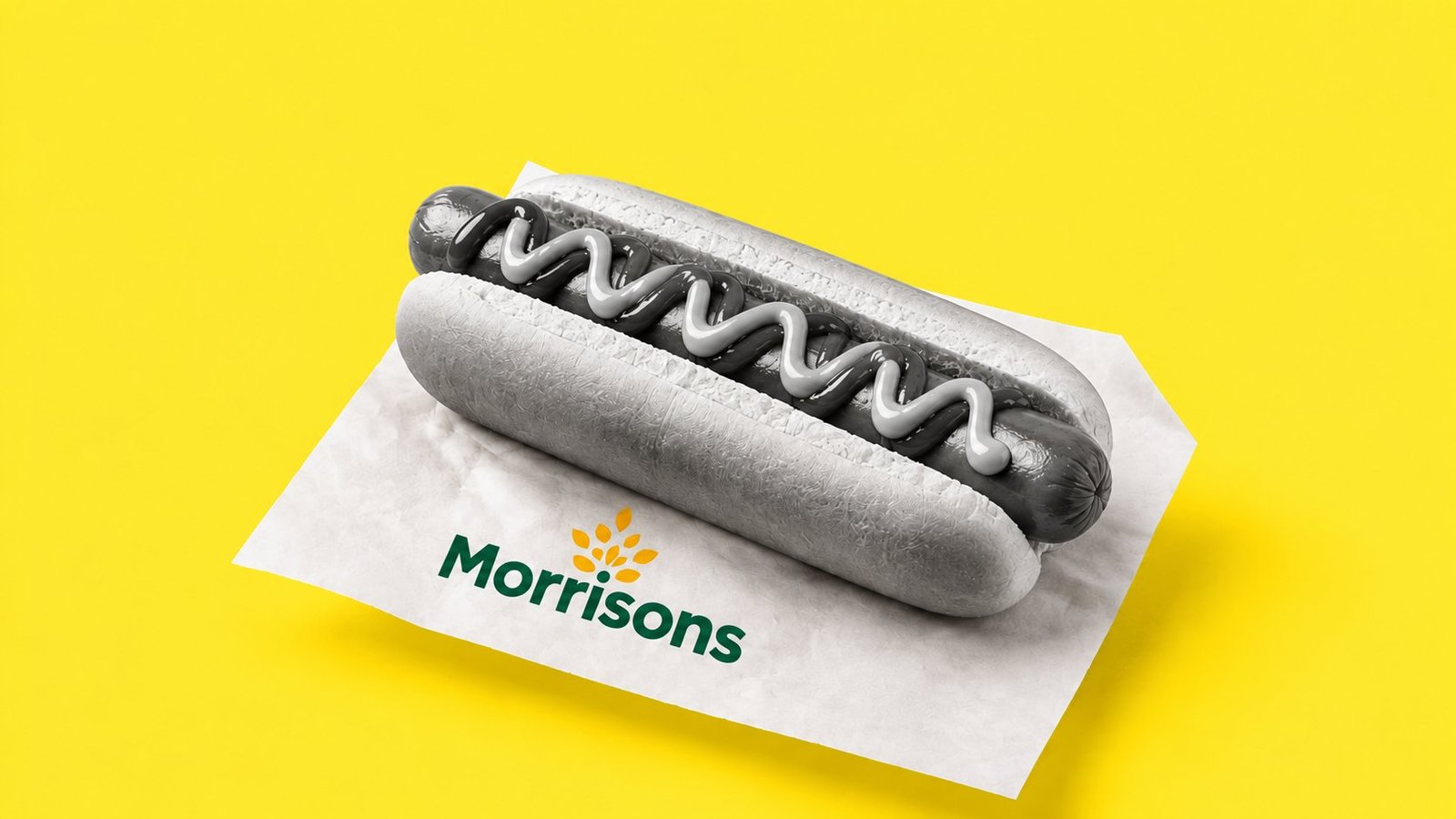
Morrisons has spent the last two years closing cafés, not opening them. In 2025 it shut 52 cafés, all 18 Market Kitchens, and dozens of counters, citing costs "significantly out of line with... the value that customers place on them." The lesson many will take from that is "in-store food service doesn't work for Morrisons." I think that's the wrong lesson.
Morrisons' cafés failed as a café format — seating, table service, a broad menu, staffing costs that don't scale with a declining footfall pattern. That's a format problem, not proof that food-as-loyalty-driver is dead.
Costco proves the opposite model works spectacularly: a $1.50 hot dog and soda combo, unchanged since 1985, sold at break-even or a loss, that exists purely to reinforce a brand promise and pull people through the door more often. No seating required. No waiters. No 18-item menu. Three-quarters of a billion combos sold a year, and Costco's membership renewal rate sits near 90%. Don't believe me — go visit any Costco food court in the States and see the lines for yourself.
My argument: Morrisons should not rebuild the café. It should build the opposite of the café — a tiny, fast, grab-and-go food counter, 3–5 items, priced to feel almost irresponsible, that exists to buy goodwill and footfall, not to turn a profit on food. It should build Morrisons' equivalent of a Costco food court.
Why Morrisons Specifically
This isn't a generic "add a hot dog stand" idea. Morrisons is arguably the best-positioned of the Big Four to do this, for reasons that are specific to its business model:
- It already manufactures food, at scale. Morrisons is the only major UK grocer with substantial vertical integration — its own manufacturing sites, abattoirs, and bakeries feeding Market Street. A grab-and-go counter doesn't require a new supply chain; it requires redirecting existing capability toward three or four SKUs instead of spreading it across a shrinking café menu.
- Market Street is the brand's actual point of difference. Morrisons' own leadership has explicitly protected Market Street as "a beacon of differentiation" even while cutting cafés around it. A true grab-and-go counter extends that differentiation into an impulse, footfall-driving format rather than diluting it into a sit-down offer nobody was using enough.
- The closures have already cleared the ground. Dozens of café and Market Kitchen spaces are now empty or being handed to third parties. That's a real estate opportunity, not just a retreat — small counter footprints are cheap to fit into spaces that used to need seating for 30.
What It Is Not
To be explicit about the boundary, because it's the point of the whole argument: this is not a smaller café. No seating. No table service. No laminated menu. No attempt to be a destination for lunch with a friend. Forget that traditional UK café style — it's dated and doesn't work anymore.
It should feel more like a kiosk than a restaurant — as close as possible to the Costco food court model and as far as possible from what Morrisons just closed.
3–5 items, chosen for two things only: extremely cheap to produce at scale, and extremely fast to serve. A very cheap pizza slice. A very cheap hot dog. Maybe a coffee, priced as a loss leader rather than a margin product the way Costa or Greggs coffee is. That's close to the whole menu.
The food counter needs to become a reason people go to Morrisons — just like the food court drives people to Costco.
The Mechanism, Stated Plainly
The pizza and hot dog are not supposed to make money. The strategic logic runs in one direction only:
Exceptional perceived value → goodwill → more frequent visits → more footfall → more grocery baskets captured on the way past → higher customer lifetime value.
Costco's own economics make the mechanism legible: the food court is a marketing line item, not a P&L line the company expects to be profitable on its own. Grocery loyalty economics work the same way Costco's membership economics do — the food isn't the product being sold, it's the reason someone chooses this store over the one down the road twice a week instead of once.
Where the Thesis Is Weakest
I want to stress-test this, not just assert it. Four places it's genuinely vulnerable:
- Costco's model depends on a closed membership loop; Morrisons' doesn't have one. Costco can afford a loss-leading hot dog because the same customer who eats it has already paid an annual fee and will renew based partly on perceived value like this. Morrisons has no membership fee to protect — the goodwill has to convert directly into extra basket spend, with no guaranteed second purchase point. That's a real structural gap, and it means the ROI case here is weaker and slower than Costco's, not equivalent to it.
- Morrisons just publicly framed food service as a cost problem, not a growth lever. Leadership's language in 2025 was about cutting things "out of line with... the value customers place on them" — a P&L-first framing. A grab-and-go counter that's deliberately unprofitable on paper will need a different internal story and different measurement (footfall lift, basket-size lift, visit-frequency lift) or it will get cut in the next optimisation round for the same reason the cafés were.
- Labour cost is still labour cost, even at a counter. UK minimum wage and employer NI costs are exactly what pushed the café closures in the first place. A grab-and-go counter is cheaper than a café per unit served, but it isn't free, and the model only works if volume per labour-hour is genuinely fast-food-restaurant-level, not slow like the old counters were.
- Discounters already own "cheap and fast." Aldi and Lidl's entire identity is value. A £1.50 hot dog at Morrisons has to be startling relative to Morrisons' own positioning to generate the goodwill effect — it doesn't need to beat Aldi's prices, it needs to beat what a Morrisons shopper expects from Morrisons. It also needs to be the extra reason someone chooses Morrisons over anywhere else.
None of these fully break the thesis, but they explain why this has to be run and measured as a loyalty and footfall investment with its own metrics — not folded into the same food-service P&L line that just got cut, and not assumed to work simply because it worked for Costco.
The Back-of-Envelope Test
None of this means anything if it can't clear a rough cost hurdle. Here's the order-of-magnitude version, built on public figures plus a small number of clearly-flagged assumptions — the kind of napkin math that should happen before anyone proposes a pilot, not after.
Daily cost of a single-store counter (illustrative):
- 2 staff on UK National Living Wage (£12.21/hr in 2025) for a 10-hour trading window ≈ 20 labour-hours/day ≈ £244, plus ~15% for employer NI and on-costs ≈ ~£280/day in labour
- Selling ~300 units/day at a per-unit subsidy of roughly £0.50 (the gap between cost-to-make and the deliberately-low price) ≈ ~£150/day in product subsidy
- Total: roughly £430/store/day, call it ~£3,000/week, or ~£155,000/year per store if run daily
What that has to buy back: Morrisons runs ~497 stores on UK grocery revenue in the region of £15bn a year — roughly £580,000 per store per week, or averaged across a trading week, on the order of a few thousand transactions a week per store (this last figure is a rough estimate, not a published one, and would need Morrisons' actual store-level transaction counts to firm up). Assuming a UK grocery basket in the low-£20s, the counter needs to generate on the order of 20 incremental baskets a day per store — baskets that wouldn't have happened, or wouldn't have been that size, without the counter — to cover its own cost. Relative to a few thousand weekly transactions per store, that's a small single-digit percentage lift in footfall or basket size.
More importantly, this could become the driver for choosing Morrisons over any other competitor — especially on Friday nights and weekends.
Why that number matters: it reframes the pilot test from "does the counter make money" (it won't, by design) to "does it move footfall or basket size by roughly 1–2%." That's a specific, measurable, achievable-sounding bar — not a leap of faith borrowed from an American warehouse club with a completely different revenue model. If a 90-day pilot can't show a footfall or basket lift in that range for the stores running the counter versus a matched control group, the thesis fails on its own terms and should be killed, not softened.
Every figure above is a deliberately conservative, publicly-sourced or clearly-labelled estimate — not Morrisons' actual costs, which would require store-level data Morrisons hasn't published. The point of including it is to show the shape of the calculation a commercial team would need to run, not to claim precision it doesn't have.
What Proof-of-Concept Would Need to Show
Before any wider rollout: a handful of pilot stores, three items maximum, prices set to feel deliberately below-market, and success measured on visit frequency and average basket size for identified frequent shoppers — not on whether the counter itself breaks even. If it can't move those two numbers in a 90-day pilot, the thesis is wrong and should be dropped, not iterated on.
About Me
I'm Michael Philippou, co-founder of Big Love, a plant-based ice cream business in Santa Monica I've been running with my wife Victoria for over ten years. Before ice cream, I was a lawyer. I write about the real, unpolished lessons of running a small business — no gurus, no hype, just what's actually worked and what hasn't — at profitlights.com, where you'll also find a few free tools and the rest of my writing. You can find more of these stories on my YouTube channel, Real Business Real Lessons, or connect with me on LinkedIn.
Want to know how your business is actually doing? Start with the free Business Health Check — a couple minutes of questions and your email gets you a real score. Or dig into the other four: Valuation Estimator, Cash Runway, Customer Concentration Risk Checker, and Break-Even Calculator.