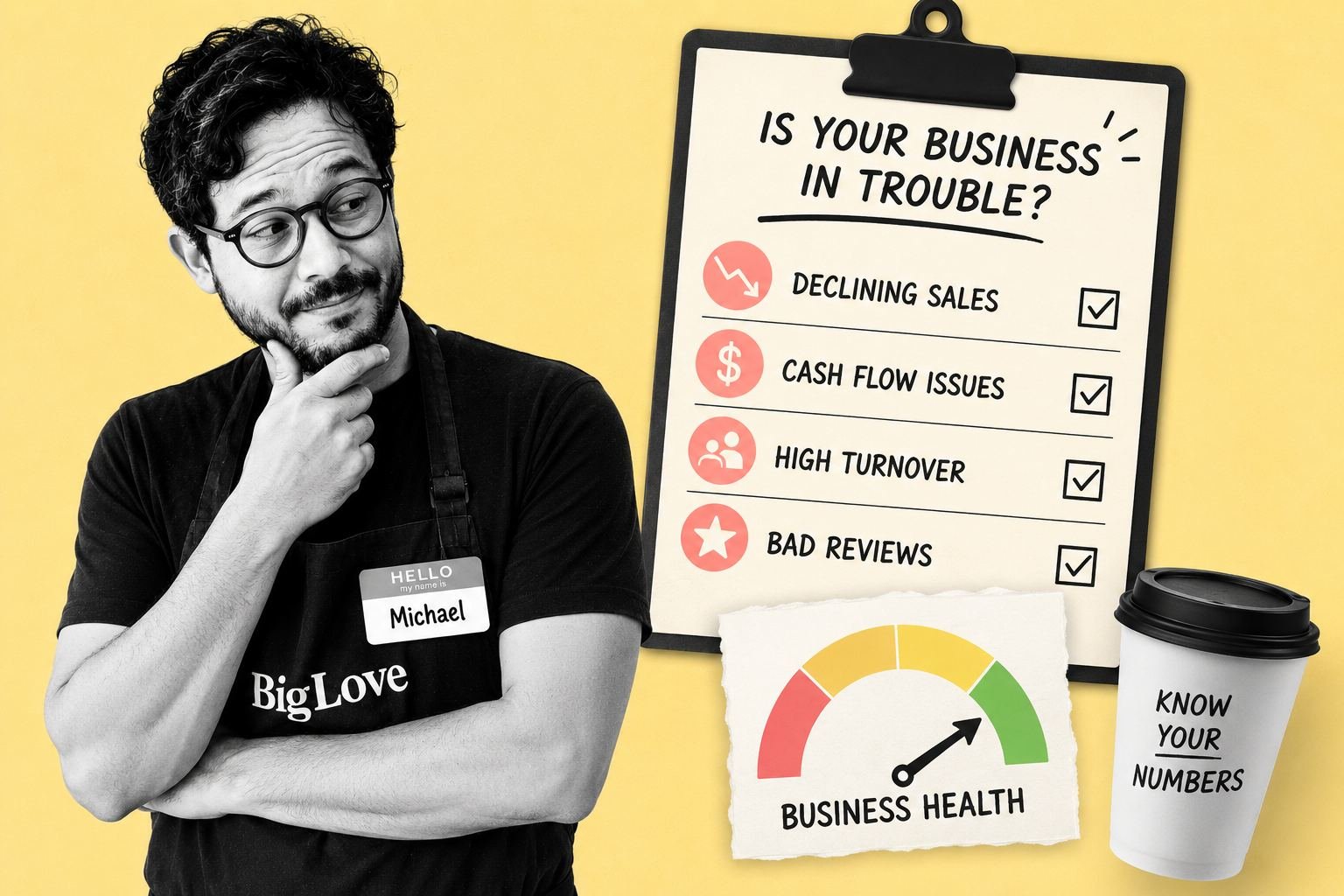
Search "signs your business is failing" and you'll get the same list, worded slightly differently, from a dozen different sites: declining sales, cash flow problems, high staff turnover, unhappy customers, missed bill payments.
All true. All useless if you're actually trying to figure out where you stand today.
Here's the problem with every version of that list: it's built for someone who's already deep in trouble and looking backward at how they got there. It doesn't help the business owner lying awake at 1am wondering if a slow month is normal, or the first sign of something worse. Because here's what nobody tells you: almost every one of those "warning signs" also happens to businesses that are completely fine. I know that because I have run my own business.
Sales dip in a slow season. A good employee leaves for a better offer. A regular customer stops coming in for reasons that have nothing to do with you. If you're checking your business against a list of scary symptoms, you'll find at least one of them most months — healthy or not.
The question isn't "do I have any of these symptoms." It's "how do these numbers actually compare to where they should be." That's a different question, and it needs a different answer.
Why "Signs" Lists Don't Actually Tell You Anything
Every symptom on those lists is real, but none of them come with a threshold. "Declining sales" — declining by how much, over how long, compared to what? "Cash flow issues" — a tight month because you just paid for inventory, or a genuine structural problem? "High staff turnover" — compared to what's normal for your industry, your size, your season?
Without a number attached, a symptom list just gives you something new to worry about. It doesn't tell you whether to actually be worried.
I've run a retail food business for over ten years. I've had slow months that felt like the sky was falling and turned out to be completely normal seasonality. I've also had months that felt fine on the surface while a real problem was quietly building underneath — the kind you only catch if you're actually looking at the right numbers, not just how busy the counter feels.
That gap — between how a business feels day to day and what its numbers actually say — is where most owners get it wrong in both directions. Some panic over nothing. Some ignore a real problem because the store still felt busy.
What Actually Tells You Where You Stand
Instead of a symptom checklist, here's what I'd actually look at if I wanted a real answer, not a scare:
1. Profit trend, not revenue trend. Revenue can grow while a business quietly becomes less healthy — rising costs, discounting to compete, more expensive customer acquisition. Revenue going up feels good. It doesn't tell you if you're keeping more or less of it than you were a year ago.
2. How dependent the business is on you personally. A business that only runs well when you're physically present isn't unhealthy exactly, but it's fragile — one bad week from you and the whole thing wobbles. This one doesn't show up in a P&L, but it's one of the first things that actually determines whether a business can survive a rough patch.
3. Customer concentration. If a small number of customers make up a large share of what you bring in, you don't have a diversified business — you have a few relationships you're hoping don't end. This is invisible in a revenue-is-up headline number and is one of the most common blind spots I see in owner-operated businesses. It's exactly what the Customer Concentration Risk Checker is built to catch.
4. Cash runway, not just cash balance. Having money in the bank feels safe. What actually matters is how many months that money would last if revenue stopped tomorrow. Those are very different numbers, and most owners have never actually calculated the second one — the Cash Runway tool does it in about 30 seconds.
5. Break-even distance. Knowing exactly how far above or below your break-even point you're operating tells you more in one number than any list of symptoms — it's the difference between "business as usual" and "one bad month from serious trouble." The Break-Even Calculator runs this exact number for you.
None of these are exotic. They're just specific, measurable, and comparable — which a list of vague symptoms can never be.
A Quick Example of Why the Number Matters More Than the Feeling
Take cash runway — how many months your business would survive if revenue stopped tomorrow. Most owners have a rough sense of their bank balance but have never actually calculated this.
Say a business has $40,000 sitting in the bank, and monthly operating costs — rent, payroll, inventory, everything — run at $18,000.
Cash runway = $40,000 ÷ $18,000 ≈ 2.2 months
That's a very different piece of information than "we have $40,000 in the bank," which sounds comfortable in isolation. Two months of runway isn't a crisis on its own — plenty of healthy, growing businesses run lean on purpose and reinvest instead of stockpiling cash. But it does tell you something a bank balance alone never will: exactly how much room you actually have before a rough quarter turns into a real problem, and how quickly you'd need to react if one hit.
Break-even distance works the same way. If your business needs $32,000 in monthly revenue to cover costs and you're currently doing $38,000, you're operating about 19% above break-even. That single number tells you more about how much cushion you actually have than any amount of "does the store feel busy" ever could — and it's the kind of thing that's easy to calculate once, and easy to forget to ever check again.
Normal Fluctuation vs. Something Worth Watching
Since almost every "warning sign" also happens to healthy businesses, here's roughly where the line actually sits:
Probably normal: a single slow month with an obvious explanation (weather, season, a nearby event pulling foot traffic elsewhere). One good employee leaving for a genuinely better opportunity. A regular customer who stops coming in for reasons you'll never know and that have nothing to do with your business.
Worth actually checking: the same softness showing up three months running with no seasonal explanation. Turnover that keeps happening regardless of who you hire or how you manage them. A growing share of revenue concentrated in fewer and fewer customers. Margin quietly shrinking even while revenue holds steady or grows.
The difference isn't the symptom — it's whether it's a one-off or a pattern, and whether you're actually tracking it long enough to tell the difference.
Getting an Actual Answer Instead of a Guess
This is exactly why I built the Business Health Check into Profit Lights the way I did. Instead of handing you another list of things to worry about, it asks a handful of direct questions about your numbers and gives you back a straightforward read — red, amber, or green — on the specific areas that actually determine whether a business is healthy, along with what to actually do about whichever one comes back red.
It takes about a minute. No financial documents to upload, no account required, no guessing which of fifteen generic symptoms might apply to you.
The Honest Answer
Most businesses aren't "failing." Most businesses are somewhere in the much larger space between thriving and failing — doing fine in some areas, quietly weak in others, and the owner has no real way to tell which is which without actually looking at the specific numbers that matter.
That's a genuinely different problem than the one every "signs of failure" article is answering. You don't need a list of things to be scared of. You need an actual read on where you stand — so you can either stop worrying about nothing, or start working on the one thing that's real.
Check Where You Actually Stand
If you want a real answer instead of another list to worry about, Profit Lights has a free Business Health Check that runs exactly this kind of assessment — a couple minutes of questions and your email gets you a real score.
Profit Lights provides an educational estimate only and doesn't replace a conversation with your accountant or a professional financial advisor about your specific situation.
About Me
I'm Michael Philippou, co-founder of Big Love, a plant-based ice cream business in Santa Monica that I've been running with my wife Victoria for over ten years. Before ice cream, I was a lawyer. I write about the real, unpolished lessons of running a small business — no gurus, no hype, just what's actually worked and what hasn't. Watch more on YouTube (Real Business Real Lessons) or follow along on LinkedIn.
Want to know how your business is actually doing? Start with the free Business Health Check — a couple minutes of questions and your email gets you a real score. Or dig into the other four: Valuation Estimator, Cash Runway, Customer Concentration Risk Checker, and Break-Even Calculator.