Ten years ago, I sold almost everything I owned, left my career in law, and moved to Los Angeles with my wife to turn the tiny ice cream business we'd started in the UK into a real storefront.
I didn't advise one. I didn't invest in one. I didn't write about one from the outside.
I ran one.
And after a decade, I've landed on something that sounds like a contradiction: small business has never been easier to start — and it has rarely been harder to survive.
Both things are true at once. That's the part nobody tells you.
We Have More Tools Than We've Ever Had
When we launched in 2016, generative AI didn't exist for us. If I wanted to check a set of figures, I asked my business partner — who's also my wife — to do it by hand. Excel spreadsheets were just data banks you still had to interpret yourself — the kind you'd spend hours building only to realize you'd never actually use them again because updating them was too complicated.
Today our point-of-sale system tracks customers, runs our loyalty program, sends marketing emails, and hands us sales data in real time. Delivery platforms let a single storefront reach an entire city. AI can draft, analyze, and brainstorm almost anything in the business on command.
These are genuine advantages. A small business today can operate with capabilities that used to require entire departments.
The problem is we still don't have the departments.
We have the same small team we always had. Technology didn't replace any of our old jobs — it just added new ones on top. Instagram didn't replace email. Delivery apps didn't replace the physical store. AI didn't replace everything else.
Every new platform is another login, another fee, another metric somebody has to understand.
In a small business, that somebody is you. In my business, that somebody is me.
Revenue Is Not Profit
This is the part I underestimated most for the first few years.
People see a busy store and assume the owner is doing well. Maybe. But sales are only the beginning of the equation — labor, rent, ingredients, credit card processing, delivery commissions, insurance, and a long list of smaller costs all take their share before anything is actually yours.
Outward appearances aren't always what they seem. Social media makes it easy to see something trendy and assume it must be making crazy money.
Right now, 12.5 to 15% of our sales come through delivery platforms — a channel that didn't exist in any meaningful way when we opened. It's real revenue. It's also revenue with a commission built in before it ever reaches us.
You can sell more and keep less. I've done it.
One of the most important skills in small business isn't generating revenue. It's understanding the numbers behind it. A busy business isn't automatically a healthy one, and growth isn't automatically success. Sometimes the smartest move a small business can make is not getting bigger — especially when the growth is being chased for ego rather than for the numbers.
I'm always in awe of the one-location businesses that have been "the spot" in their town for decades, run by the same family the whole way through. They'll never be a household name in America. Growth wouldn't make them better — it might make them less special. That's not true for every business model, but it's the one I think we're all too quick to dismiss.
The Owner Is Both the Strength and the Weakness
Here's the contradiction at the center of all of it.
The owner is usually the reason the business works. They notice things nobody else notices. They know the customers by name. They stay late when something breaks. They care because their money and their livelihood are on the line like no one else's. I know, because that's me. I've felt it. I've been there. I wear this hat.
That's not a personality trait — it's the actual mechanism that keeps a small business alive when there's no department to absorb a bad week.
But that same mechanism is the business's biggest single point of failure.
A large company can eat a $10,000 mistake and nobody outside finance ever hears about it. For a small business, $10,000 is a different kind of conversation — and there's no one else to hand it to. Tell a small business owner they need $5,000 for a new commercial freezer, and I promise you it will hurt them.
Equipment breaks. Someone calls out. A promotion flops. It becomes your problem, immediately, because there's no layer between you and the outcome. I know, because I'm the stopgap. I understand that. I accept it.
And unlike a large company, there's often nobody waiting behind you when you're exhausted, sick, or simply need a break. I know because I had to step up and scoop ice cream after breaking my wrist. I know because I put off seeing a doctor for pneumonia until I was the sickest I've ever been, because someone had to make sure everything else was okay first.
Control and responsibility arrive as a package. You don't get one without the other.
So Is Small Business Broken?
No. I think it has real advantages in 2026 that didn't exist a decade ago — speed, direct access to customers, the ability to change course without a committee. Starting one has never been more accessible: you don't even need an idea anymore. You can just ask AI, "I want to start a business, what should I do?"
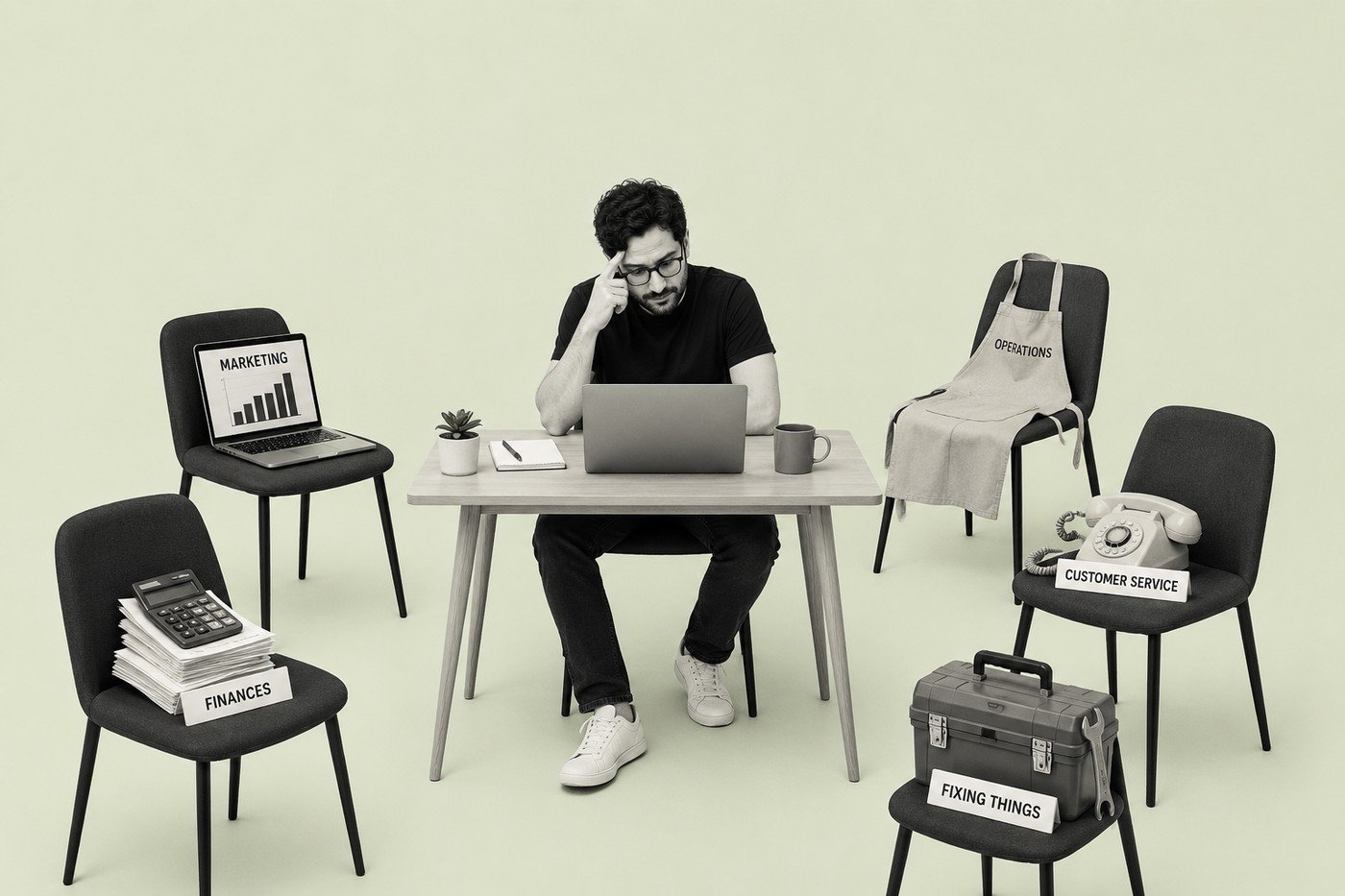
But none of that makes staying open easy. If anything, it's made the job broader. The modern owner isn't just an owner. They're part marketer, part accountant, part recruiter, part operator, and occasionally part repair technician — often all before lunch.
One word explains what's actually changed in 2026: attention. A business can't get away with waiting for people to find it by word of mouth or by walking in off the street anymore. I learned that the hard way — I took twelve days off and paused our social media because I was, reasonably, on vacation. Our sales dropped 25%. Not because people stopped caring. Because there's more noise than ever, and something shinier is always one scroll away.
AI can help you start a business. It won't clean your store, replace the employee who "doesn't get it," or remind people you exist. That part's still yours.
What hasn't changed, and what I don't think technology will ever replace, is this: the business still runs on one person who cares more than they're paid to, absorbing what nobody else is positioned to absorb.
Being small was never something to overcome.
It's still the advantage — as long as you understand exactly what it costs you.
About Me
I'm Michael Philippou, co-founder of Big Love, a plant-based ice cream business in Santa Monica that I've been running with my wife Victoria for over ten years. Before ice cream, I was a lawyer. I write about the real, unpolished lessons of running a small business — no gurus, no hype, just what's actually worked and what hasn't. Watch more on YouTube (Real Business Real Lessons) or follow along on LinkedIn.
Want to know how your business is actually doing? Start with the free Business Health Check — a couple minutes of questions and your email gets you a real score. Or dig into the other four: Valuation Estimator, Cash Runway, Customer Concentration Risk Checker, and Break-Even Calculator.